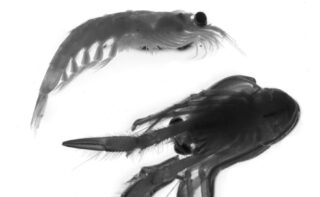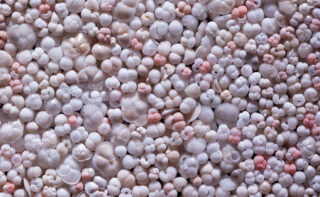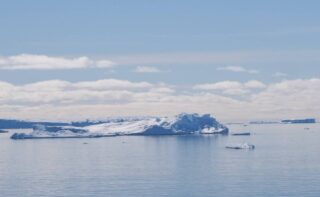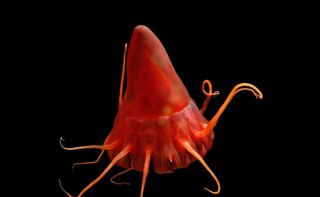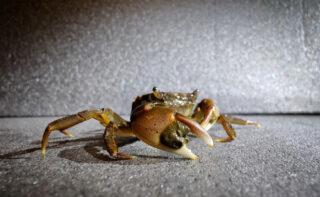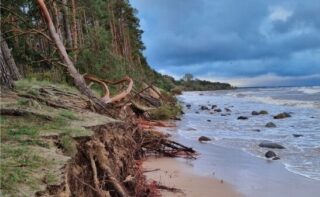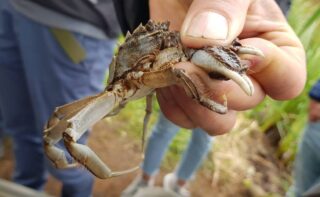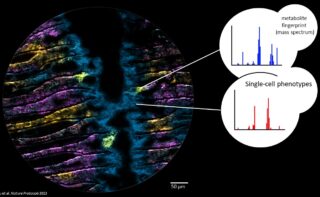
© © Sina Ettmer | AdobeStock News All press releases and news from the DAM All news All Topics Biodiversity Climate Change Management Pollution Research Structure Usage All Strategy Groups Marine Sozial- & Kulturwissenschaften Mineralische Ressourcen Ozeanzirkulation und Klima ZFO DAM news only Adapting to hypoxia: Zooplankton influence the efficiency of the biological carbon pump in the Humboldt Current off Peru arine organisms play a crucial role in the global carbon cycle. Phytoplankton absorb carbon dioxide from the atmosphere and sequester it in organic matter that sinks to the deep ocean where it can be stored for long periods of time. Until now, this process – the biological carbon pump – was thought to be particularly efficient in oxygen-poor areas. A new study by researchers at the GEOMAR Helmholtz Centre for Ocean Research Kiel suggests that the influence of certain zooplankton species on the biological carbon pump has been underestimated. The scientists have published their findings in the journal Communications Earth & Environment. Climate change could trigger methane release from the deep ocean Why regional differences in global warming are critical Tiny fossils in marine sediments verify that climate models provide accurate calculations of average ocean temperatures during the last glacial maximum around 20,000 years ago, but that the spatial distribution of simulated temperatures is too uniform and thus only partially valid for predicting future climate. A new method now shows how past climate model simulations can be better assessed. Dr. Lukas Jonkers of MARUM – Center for Marine Environmental Sciences at the University of Bremen, and his team of colleagues, have now published their results in the journal Nature Geoscience. Being prepared for storm surges on the Baltic Sea coast Kiel researchers evaluate the future protection potential of dikes and show flooding scenarios for the German Baltic Sea coast until 2100 Research vessel Polarstern sets course for the East Antarctic Yesterday evening, the research vessel Polarstern set off from Cape Town for a special region: Two expeditions in East Antarctica will focus on the history of the instability of the ice sheet there and its interactions with ocean circulation. On the first leg, which will last around two months and be led by GEOMAR, the main focus will be on oceanographic, geoscientific and biological work; the second leg will be led by Kiel University and will have a geoscientific focus, with researchers from the Alfred Wegener Institute involved in both expeditions. The change of personnel and ship supply will take place in Hobart at the beginning of February. On the occasion of the Polarstern’s first call in an Australian harbour, an exchange with representatives from science and politics is planned. Speeding up knowledge generation in a transparent and responsible way Best Practices Guide to Ocean Alkalinity Enhancement Research published in State of the Planet and launched at United Nations Climate Change Conference Deep-sea mining and warming trigger stress in a midwater jellyfish New study led by GEOMAR provides insight into the effects of sediment plumes A strong call for ocean science to lead climate solutions Partnering with other leading scientific and stakeholder organisations, GEOMAR Helmholtz Centre for Ocean Research Kiel participates in this year’s United Nations climate change conference in Dubai, United Arab Emirates. GEOMAR contributes to the Ocean Pavilion, a central hub for leveraging ocean science and solutions for the climate crisis coordinated by the Woods Hole Oceanographic Institution (WHOI) and Scripps Institution of Oceanography. Today, the partners call on world leaders to enhance protection of the ocean and expand the observational capacity that is the foundation of the scientific evidence to guide progress in the “Dubai Ocean Declaration”. Non-native diversity mirrors Earth’s biodiversity New Study Reveals Huge Potential for Future Waves of Invasive Species Climate and the coast New GERICS study finds that scientific articles on adapting to climate change lack focus on implementing adaptation solutions Much more than waste: Tiny vesicles exchange genetic information between cells in the sea Extracellular vesicles play a much greater role in horizontal gene transfer in the ocean than previously assumed. Invasive Chinese mitten crabs: New project launched to preserve native ecosystems The international project “Clancy” is intended to find suitable strategies for combating the countless Chinese mitten crabs in Northern European river systems Plastic Web Quiz Hereon's Coastal Pollution Toolbox online application provides scientific fact checks and background information on plastic Geological drilling mission in West Antarctica’s interior Environmental conditions at the time of their formation in a 2°C warmer world The metabolism of bacteria under the microscope German researchers are developing a method that reveals the chemical communication between microbes and their host Previous 1 … 30 31 32 … 52 Next Share this page DAM-Newsletter Always up to date with the DAM newsletter. (German only) Subscribe Our Sponsors The federal government and the governments of the five northern German states support the current development and sponsor the DAM.