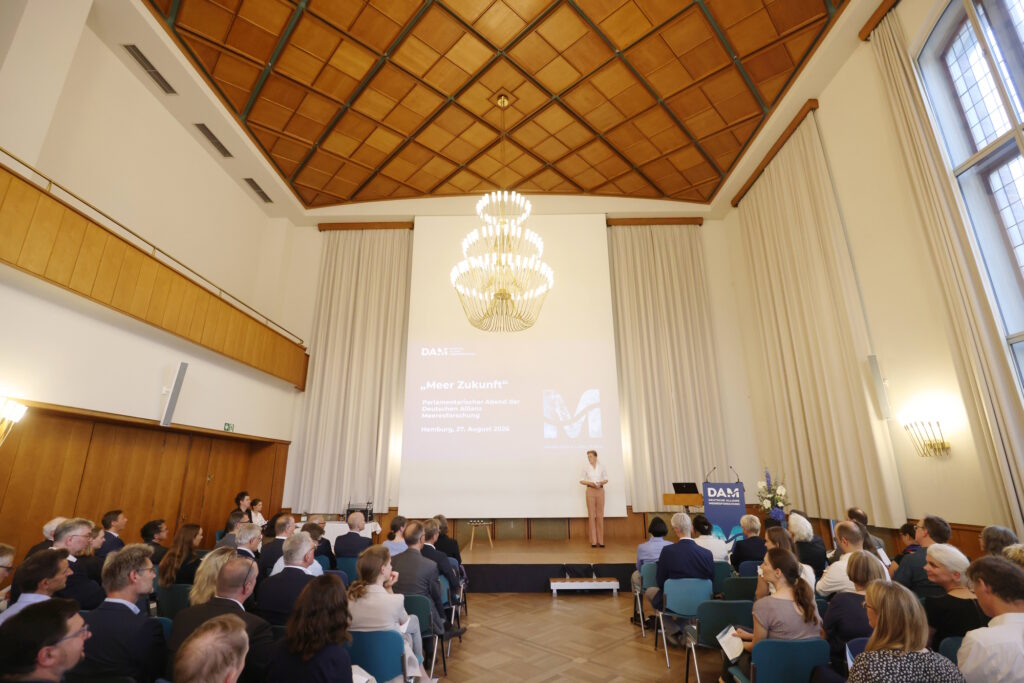
SeaFuture in Hamburg
A DAM parliamentary evening highlighted the role of research in the tension between the use and protection of Hamburg’s Elbe River
Rising sea levels, changes in the Elbe estuary, pollutants flowing from the Elbe into the North Sea, and emissions monitoring in shipping: At the German Marine Research Alliance’s (DAM) parliamentary evening on August 27, 2026, it became clear that reliable data from marine and climate research can help answer some of Hamburg’s key questions about the future.
Together with around 40 guests from politics, business, and civil society, the researchers discussed the contribution science can make to climate protection, planning for the future, and the sustainable use and protection of coasts and oceans. The message of the evening: Data and insights from marine and climate research form an important foundation for securing Hamburg’s future. As a partner in shaping the future and providing essential public services, science can provide actionable knowledge to help make sustainable political, economic, and social decisions and promote necessary innovations—with an impact extending far beyond the city limits. To do so, it needs reliable, forward-looking funding.
“To protect and preserve our oceans, we need practical knowledge so that we can make the right decisions today for tomorrow. That is exactly what the DAM provides,” explained Hamburg’s Senator for Science, Maryam Blumenthal, in her welcoming remarks. “To overcome the crisis facing the oceans, ocean research needs a reliable foundation. Especially following the positive evaluation, continuing the DAM is now the logical next step. The DAM is a best-practice example of a federal-state-funded alliance in which institutes collaborate across borders and research is application-oriented from the very beginning. Hamburg is proud to be part of one of the world’s largest marine research alliances.” She encouraged the scientists in attendance to speak out as a strong public voice—and to continuously provide critical oversight of policy-making.
Seas and oceans are among the Earth’s most important ecosystems and play a central role in global climate processes. Their condition is deteriorating rapidly due to pollution and overuse. To preserve the seas and oceans as the foundation of our lives, the DAM has set itself the goal of promoting the sustainable management of coasts, seas, and oceans by drawing on the collective knowledge of German marine research and engaging in dialogue with political and societal stakeholders. As a city of over a million people located at the mouth of the Elbe River, directly adjacent to the UNESCO World Natural Heritage Site of the Wadden Sea, and as a port metropolis with global responsibility, Hamburg is directly linked to the challenges of climate change, maritime transformation, and marine conservation—and, as a hub for international marine policy and a leading center for German climate and marine research with close ties to the maritime economy and the port, offers a particularly suitable setting for deepening the dialogue between science and politics.
Planning for the Future: Policy-Making Based on Scientific Evidence
Four scientific presentations highlighted the role that marine and climate research can play in reconciling the use and protection of the Elbe River in Hamburg—while also outlining the science-based policy measures needed to achieve this:
- Climate Protection in Hamburg: Marine and Climate Research as a Strategic Public Service
Rising sea levels, more frequent and severe storm surges, and extreme low tides pose a direct threat to Hamburg as a port city and metropolis. The marine research institutions represented in the DAM conduct the coastal and ocean observations that Hamburg needs to make informed decisions on climate adaptation, explained Johanna Baehr, professor of climate modeling at the University of Hamburg. High-resolution storm surge models and projections for rising sea levels in the German Bight, for example, are an indispensable foundation for ensuring the long-term stability of dikes, HafenCity, and the Elbe marshes.
For policymakers, this leads to recommendations to incorporate scientific findings into all long-term investment and planning decisions—and to ensure the continued funding of research. Climate projections and coastal monitoring must also be recognized as critical infrastructure and secured for the long term.
- The Elbe Estuary: Lifeline, Climate Buffer, and Economic Engine
The Elbe estuary is both a shipping route and a highly complex ecosystem: floodplains, salt marshes, and mudflats play a central role in climate, flood, and nature conservation, explained Dr. Frank Kösters, head of the Coastal Hydraulics Department at the Federal Institute of Hydraulic Engineering (BAW). Sediment management, channel modifications, and climate change are fundamentally altering the system. The Port of Hamburg will remain competitive only if sediment conditions, water depths, and estuarine dynamics are scientifically understood and proactively managed. To achieve this, an interagency strategy is recommended that integrates port operations, hydraulic engineering, and nature conservation on a scientific basis. Particular attention must be paid to preserving biodiversity in the Elbe estuary and the adjacent North Sea, which forms the foundation for fisheries, tourism, and natural coastal protection.
- Pollutants: Global Responsibility Starts Locally
Pollutants and microplastics enter the North Sea via the Elbe River, affect areas as far as the Wadden Sea and the open sea, and return through the food chain. These land-river-sea transitions are systematically documented by, among others, the Federal Maritime and Hydrographic Agency (BSH) and the Helmholtz Center Hereon. As one of Europe’s largest ports, Hamburg has the reach and the responsibility to set ambitious standards, stated Prof. Ralf Ebinghaus, director of the Institute for Coastal Environmental Chemistry at Hereon. The resulting recommendation for environmental policy is to consistently consider land, rivers, and the sea as an integrated whole—with enhanced pollutant controls in urban areas and in shipping, as well as ambitious limit values for long-lasting and harmful PFAS compounds, known as “forever chemicals.”
- Clean shipping requires measurable limits
Hamburg is Germany’s largest shipping hub. Strict international environmental regulations and global competition are driving the shift toward climate-friendly propulsion systems and autonomous shipping, explained Katrin Ewert, head of the Maritime Environmental Protection Division at the Federal Maritime and Hydrographic Agency (BSH). The sector has already adapted noticeably: Most ships have been retrofitted or converted to low-emission and alternative fuels. This implies that policymakers must establish a modern, automated system for monitoring ship emissions as a prerequisite for clean air and fair competitive conditions—as well as develop measurement methods and threshold values for pollutants that have not yet been regulated.
Dr. Kerstin Jochumsen, head of the Department of Oceanography at the BSH and a member of the DAM Board of Directors, emphasized that marine and climate research in Germany—and specifically in Hamburg—is very well positioned to address complex topics and future challenges, as outlined in the presentations. The role of research, she said, is to raise awareness of complex issues, illustrate interconnections, and provide solution-oriented practical knowledge—thereby ensuring that research findings have a tangible impact on society. Interdisciplinary and cross-institutional scientific collaboration, such as that seen in the DAM research missions CDRmare, sustainMare, and mareXtreme, offers real added value in this regard. She invited those present to remain in ongoing dialogue—including through events such as this parliamentary evening.
***
The German Marine Research Alliance (DAM) brings together 25 leading German marine research institutions with the goal of strengthening the sustainable management of coasts, seas, and the ocean through research, knowledge transfer, data management, digitization, and infrastructure. To this end, the DAM works with its member institutions to develop solution-oriented knowledge and communicate options for action to policymakers, the business community, and civil society. It is funded by the federal government and the northern German states of Bremen, Hamburg, Mecklenburg-Western Pomerania, Lower Saxony, and Schleswig-Holstein.
DAM-Newsletter
Always up to date with the DAM newsletter. (German only)
Our Sponsors
The federal government and the governments of the five northern German states support the current development and sponsor the DAM.